The present hot topic for everyone is how best to curb the corporate and financial excesses and risky behaviour that lead most of the world's economies into the worst recession since the Great Depression. However, the '800 pound gorilla' in the room that this debate neglects is the lack of transparency that senior executives have over their operations and initiatives, and the perverse incentives this creates.
In the English-speaking world, key policymakers and the public at large have taken up the mantle of improving corporate governance, more specifically limiting corporate remuneration, as a way to check senior executives' and bankers' appetite for risky, even illegal, short-term profit maximising that can inject dangerous volatility into financial systems and markets.
In Australia, APRA recently proposed new executive compensation guidelines, and the ASX Corporate Governance Council is considering issuing guidelines that would require ASX-listed companies to maintain records of their briefings with analysts, provide advance notice and make them more widely accessible to provide for the more equal and fair dissemination of information.
In the UK, a recently published government-commissioned report on corporate governance by Morgan Stanley senior adviser David Walker recommends that banker pay be awarded on a long-term basis and would subject banker bonus payments to close public scrutiny. In the US, there is a compensation 'czar' tasked by the US Treasury to reign in senior executive compensation at companies that received government bailout funds.
I can see and appreciate the logic in addressing the perverse incentives that currently reside within executive and banker compensation structures. But, this is only one side of the equation. The other side involves the fact that senior executives within many organisations can not clearly and accurately identify, measure, and manage their internal costs and value-creation activities.
Unfortunately, in many instances, senior management is making important strategic and investment decisions based on experience, 'gut feels', and/or short-term, known measures, such stock price and personal compensation targets - which in the US, especially, normally consists of stock and option grants. Arguably, this inability to identify, measure and manage organisational costs and benefits encourages senior management to focus more on more short-term, tangible performance metrics (i.e., personal remuneration targets) at the expense of longer-term initiatives whose benefits are at best uncertain.
At mbh, we regularly provide technology solutions and consulting services to organisations that lack the internal processes and technology for clear assessment of operational costs and the value potential of initiatives. We developed our web-based, enterprise project portfolio management software solution, UniPhi, to address what we see as an alarming lack of operational and strategic transparency within most organisations.
We believe that any organisation with 100 or more people should adopt an enterprise-level project portfolio management system to provide greater transparency of operational costs and the initiatives most likely to add, or destroy, value. By equipping senior executives with this knowledge, they will be more inclined to behave in the interests of the organisation, because they'll have a better understanding of what is really happening and can take appropriate steps.
In addition, this greater transparency allows for better accountability, since the information resides within the project portfolio management system for the entire organisation to see. This should dramatically lessen management's incentives to engage in short-term, self-serving, and possibly illegal, activities, since the possibility of disclosure is heightened.
A project portfolio management system also assists the Board of Directors in carrying out their oversight duties, given they will have a much better grasp of what is occurring within an organisation at the strategic and operational levels. This system also assists in accurate public financial reporting, since everyone across the organisation will be working from the same set of financial data.
For many organisations, this increased transparency may fell like an uncomfortable 'shock' to the system. However, it is much more preferable than having politicians manage your organisation after some catastophe. Just ask Bank of America, who is paying back its bailout funds early, because it believes the US Treasury's executive compensation restrictions prevent it from attracting a qualified successor to its outgoing CEO.
Enterprise project portfolio management may not be the proverbial 'silver bullet' for the corporate governance problem, but it definitely enhances internal corporate transparency, and thus accountability, which is a step in the right direction.
Friday, December 04, 2009


Sunday, October 18, 2009
banks and managers as agents for owners
It's going to be a very interesting 12 months in relation to bank profits. The profit made by Goldman Sachs and the quick return of smugness in the industry is a fascinating example of arrogance that completely destroys self reflection. I'm hoping the jury is still out and that someone within the industry will pull the various egos in a room, bang their heads together and then some sense ensues. The banks have generated such a phenomenal amount of destruction to market based capitalism it is one of life's great examples in arrogance in ignorance. The biggest challenge to market based capitalism for me is the challenge that banks bonuses paid to employees has proven beyond a doubt the importance of owner based management. In fact Adam Smith asserted that self interest will be guided by the invisible hand to generate public good only if the owner is also the manager. Of course, the leverage of the manager being an agent for the owner is crucial to modern market economies but the abuse of this agency power by bank employees has thrown all the benefits of this leverage to the wind.
So, lets see how the public reacts to this new arrogance of the banks that has occured so soon after these same bankers were on their knees begging the public for help.
Saturday, September 12, 2009
doing business in developing countries
The latest issue in China with Mr Hu being arrested on "espionage" charges has generated a number of thoughts for me. Since 2006 I have been working with various people in the Australian cattle industry to generate markets for our marvellous cattle genetics and breeding knowledge. The important note here as background information (for blogs to be written later) is that the product is knowledge. To date, the success has been in the sale of physical seed stock both to China in the form of dairy seed stock and Russia in the form of beef seed stock. To call it a success is to have a very low hurdle for success but is made on the basis of the difficulties in opening up new markets in developing countries with more complex political systems.
I'm not sure about other countries but I have first hand experience of the two countries mentioned; China and Russia. These two countries are incredibly hard places to do business. The rules are so different to Australia that Australian businessmen can never confidently do business in these countries and are in constant peril of selling their souls to get the job done (as an example, IKEA has finally decided that it's best to stop investing in Russia....for now http://www.businessweek.com/globalbiz/blog/europeinsight/archives/2009/06/ikea_turns_sour.html).
The contradiction with all this is that both China and Russia are such beautiful countries and in terms of business have so much potential. I presented to the Russian Agricultural Minister in 2006 a proposal for Australia to export USD300m worth of Beef seedstock and USD300m worth of knowledge and infrastructure development. The research and planning that went into this proposal was massive and the strategy was snapped up by the Russian government. Within 3 months they had ordered massive amounts of seedstock breeders from Britain! Fortunately an outbreak of foot and mouth in Britain killed the deal, but why did Russia take our proposal and run to Britain with it. Since this time, I have seen versions of my proposal (even word for word) in a variety of different Russian business proposals to the Ministry for funding. However, support in Australia for doing business in Russia (and more particularly, on selling our cattle IP) is difficult to obtain. Elders have sold some shipments to Russia since my proposal but the on-sell of services hasn't occurred and the numbers of cattle are far short of what they could be. I do know that Rural Solutions in Adelaide are working on some great proposals for the Russian regions but again, little has come of it in terms of hard core investment by the Russian government.
The story is little different in China. The Australian beef cattle industry has been battling for years to get some traction in developing China's beef production with not a single sale to show for it. My experience and conversations I've had with others has given me first hand anecdotes of the frustrations businesses seem to have in operating in these countries. In Russia, corruption seems to significantly reduce the amount of investment and hence the growth that's possible. In China, the ever present oversight of government control makes it extremly difficult to utilise traditional marketing practices of differentiation and segmentation to make headway. It's more about connections and alignment to the current central plan. And yet, China continues to boom and with their switch from exports to internal infrastructure investment, looks like continuing to boom.
It seems that most people think that establishing operations in these great and populace countries is just too hard, and my suspicion is that the Hu case is only going to make this perception more entrenched, much to the disadvantage of all the world over.
Sunday, July 26, 2009
energy
There's been much debate and blogging time being spent on the need for political action to prevent global warming but I wonder how much positive impact politicians can make in this area. It's highly likely that politics can slow down the transition to "clean" energy (today's clean energy will be tomorrow's pollutants as we run out of silicon, lithium and other essential ingredients). However, can legislation really speed up the natural progression to this new energy world? Maybe the world would transition quicker if the world's politicians managed to negotiate a policy framework that priced carbon dioxide effectively but when in history have politicians been able to legislate a market price?
The articles referenced at this blog http://peakenergy.blogspot.com/2009/07/monumental-failing.html (a great consolidator of information by the way) demonstrate my point. It is unrealistic to think that politicians will create a world wide policy framework that will abate the affects of global warming. However, it is less unrealistic to think that the natural reduction in the cost of renewables will drive a far quicker transition through market forces than any policy ever could. Energy is the largest industry in the world and the opportunity to get a slice of this industry into the future means that there will be millions of people world wide trying to invent product. Barriers to entry were massive while oil and coal dominated the landscape, but now, these barriers have been lowered (mainly by the success of renewables supported by the focus on issues such as global warming and peak oil). New players will emerge while the encumbents scramble to change their business models and resist the transition as much as possible. These encumbents are powerful, but political incompetence may actually be hindering them even while their lobbying efforts continue to have a significant effect.
In fact, Alan Kohler's article shows how political incompetence could actually assist more than political competence. The strain that the uncertainty caused by a garbled CO2 policy has put on the coal industry is in fact having the same effect as a carbon price would. Coal fired plants are now being viewed as expensive due to their uncertain future. This will drive investment in solutions and because the coal industry is finally being hindered in competing for these solutions, less money will be wasted on the fanciful idea of carbon capture.
Thursday, July 09, 2009
proposal writing
It's been a bad week for mbh this week. We've missed a number of proposals we'd submitted and with staff either sick or on leave, it's taken all our experience in prioritisation and workload management to make sure we keep supporting our clients to the same extremely high standard they've come to expect. Still for every bad week there tends to be a good one so after a couple of days of reflection, I'm now in the lessons learnt phase of the week. I always tend to learn more from things that go wrong than right.
This week's lessons are around proposal writing and having just finished a proposal 15 minutes ago ( and having committed to maintaining this blog) I thought I'd sign in and write down some random thoughts. After finishing the proposal, I asked my partner to have a read and give me her thoughts. Thankfully, she has far superior intellect than me and her communications degree certainly assists in challenging my arguments. Her comment this time related to the use of the term "hot" when referencing a product that is doing well at the moment. We have a four hour project planning course that takes people through a crash course in critical path analysis and network crashing. This course is very popular at the moment and I referenced this in the proposal as a "hot" product. My partner's challenge was "is this formal enough for a proposal" and my response at the moment is yes for when you are competing in bloody red ocean (which we are when it comes to PM training), one has to differentiate yourself as much as possible. However, as always, the doubts creep in.
Thoughts please, is using the term "hot product" too informal for a business proposal?
This week's lessons are around proposal writing and having just finished a proposal 15 minutes ago ( and having committed to maintaining this blog) I thought I'd sign in and write down some random thoughts. After finishing the proposal, I asked my partner to have a read and give me her thoughts. Thankfully, she has far superior intellect than me and her communications degree certainly assists in challenging my arguments. Her comment this time related to the use of the term "hot" when referencing a product that is doing well at the moment. We have a four hour project planning course that takes people through a crash course in critical path analysis and network crashing. This course is very popular at the moment and I referenced this in the proposal as a "hot" product. My partner's challenge was "is this formal enough for a proposal" and my response at the moment is yes for when you are competing in bloody red ocean (which we are when it comes to PM training), one has to differentiate yourself as much as possible. However, as always, the doubts creep in.
Thoughts please, is using the term "hot product" too informal for a business proposal?
Wednesday, July 08, 2009
strategy execution
Over the years, this blog has been poorly maintained. One of the frustrating things is feeling constrained in being able to write the things I verbally comment on during the day. I'm a fairly argumentative person and have strong and passionate views. These views can land you in hot water if you don't think them through. When speaking, there's always the feedback loop from the listener in the form of them replying but also in terms of their body language that assists me to determine if I'm going too far. On the web, through a blog, this is much different. However, there is the opportunity to reach a far wider audience and obtain some validation or repudiation on thoughts and ideas. So, I am determined to make another attempt at regular blogging. On this occasion, my blogs will be less researchy "white papers" and more just random thoughts and observations about what happened during the day.
Any thoughts?
Sunday, January 04, 2009
what happens when a company achieves its vision?
One of the interesting things that is commented on in change management texts and can be observed as a frequent phenomena for nearly every company that has ever succeeded is the plateau and slow decline that occurs once they have achieved what it was that they originally set out to achieve. This diagram below best illustrates what I'm talking about: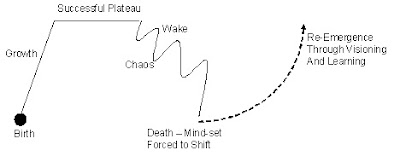

This graph demonstrates the linear growth trajectory of a successful start-up. However, once the initial vision has been reached and the product range that supported that vision is no longer unique, success plateau's and finally starts to fall. During this contraction phase, a serious of wake-up spikes occur where management reacts to the fall and tries new strategies to re-invigorate the company. However, the loss of an end state (see previous post) means that none of these periods last very long and are always followed by an even sharper fall. Finally, pending doom either results in bankruptcy and death or the re-emergence through a new vision and new mind-set of the organisation. Of course, there are many permutations in how these events take place, but in each permutation the overriding problem of a loss in ends state or vision driving failure. Often it is hard for the original successful organisation to let go of its sacred cows. These are, after all, the things that made them successful in the first place. But, ultimately, what will make the company grow again is an organisation the barely resembles the original at all. Some examples of this may help:
Having nearly died at the end of the 90s, IBM re-invigorated itself to the point where it no longer manufactures computers and makes nearly all its revenue from IT services and software(who would have thought that in the 80s).
Apple went through a tortuous period during the 90s and nearly went out of existence before its original founder created a new vision for the company centred around sleek design that has led to the iPod, iPhone and even a re-emergence of its original Mac product.
Apple went through a tortuous period during the 90s and nearly went out of existence before its original founder created a new vision for the company centred around sleek design that has led to the iPod, iPhone and even a re-emergence of its original Mac product.
Yahoo is currently going through a period of chaos centred around identity (will it re-emerge or die)?
General Motors is representative of the automotive industry in general but as been slower to respond. It is going through a period of chaos centred around a lack of vision now that its big is beautiful vision has been cast aside by society. Will it re-emerge along with the automotive into the new world of electric powered automobiles. There's no doubt in my mind that this is the vision to aspire to in the automotive industry and several organisations have taken up the challenge of meeting this all electric vision (e.g. Better Place, Nissan etc). Progress has been remarkably rapid due to their commitment to a vision they know is real.
What can we learn from this? The truth is that it is difficult to move a big ship once its course has been set and if you don't set a new destination once you reach the original one, you will fail. However, methodologies and tools to do this re-alignment are few on the ground. We have some ideas but are yet to really test them in the marketplace. Any thoughts?
Monday, September 08, 2008
examples of problems that need an end state
What I love about mbh and my role in the company is that we often get involved in developing cases for companies and governments to invest in potential solutions. What is frustrating, as per my previous post, is the lack of an overall guiding goal or end state to weigh up the worth of these investments. There are many large problems facing society that are being commented on in the mainstream press. What is often lacking from these commentaries is the end state or new world that we are trying to achieve.
The two main examples where we have been involved lately or where I have taken a personal interest is the current water and energy problems around the world. While both problems are world problems, their end state scenarios and solutions to reach said end states differ from region to region. At the moment, global warming and peak oil are being blamed for high energy prices and for problems countries are having with supplies of water. The amount of data in the marketplace on these two causes of problems (i.e. global warming and peak oil) is huge. As an example, check out this awesome website on energy http://peakenergy.blogspot.com/. Not only are the blog entries great, there are dozens of links to excellent and reputable websites for further information. It would be possible to write a business case on a variety of investment opportunities from the date linked within 6 degrees of separation from this one site. The problem would be distilling so much information.
It is almost impossible to distill information and analyse options if we don't know the end state of what it is we're proposing. However, once you put a stake in the ground, or define an end state, the options for investing are reduced to those that facilitate achieving the end state. As an example, this link to a video of a school friend of mine talks about a stake in the ground on CO2 emissions http://www.youtube.com/watch?v=wbwxF47x5ss. What Saul does is suggest an end state stabilisation of CO2 and then discusses how much demand needs to be reduced by as one option to achieving this end state CO2 figure.
The two main examples where we have been involved lately or where I have taken a personal interest is the current water and energy problems around the world. While both problems are world problems, their end state scenarios and solutions to reach said end states differ from region to region. At the moment, global warming and peak oil are being blamed for high energy prices and for problems countries are having with supplies of water. The amount of data in the marketplace on these two causes of problems (i.e. global warming and peak oil) is huge. As an example, check out this awesome website on energy http://peakenergy.blogspot.com/. Not only are the blog entries great, there are dozens of links to excellent and reputable websites for further information. It would be possible to write a business case on a variety of investment opportunities from the date linked within 6 degrees of separation from this one site. The problem would be distilling so much information.
It is almost impossible to distill information and analyse options if we don't know the end state of what it is we're proposing. However, once you put a stake in the ground, or define an end state, the options for investing are reduced to those that facilitate achieving the end state. As an example, this link to a video of a school friend of mine talks about a stake in the ground on CO2 emissions http://www.youtube.com/watch?v=wbwxF47x5ss. What Saul does is suggest an end state stabilisation of CO2 and then discusses how much demand needs to be reduced by as one option to achieving this end state CO2 figure.
I'd be interested to know societies expectations on these matters. It would certainly lead to better investment decisions if we debated what goal we were aiming for. Two answers I'd like are around water supply and energy use:
- Is Sydney and most other Australian cities happy with permanent water restrictions or do we feel an end state of watering our concrete whenever we feel like it should be the goal or is it somewhere in between?
- Is the industrialised world satisfied with Saul's reduction in consumption to meet global warming or the fact that we're going to lose various islands, flood parts of every coastal town in the world and have far more frequently dramatic weather events ok with is? Or again, is it somewhere in between and if so, what?
I know in a democracy that a definitive answer to these questions is impossible but gleanings as to general collective preferences would make government investment decision making a whole lot easier.
Sunday, September 07, 2008
ramblings on investment decision making
I've been doing a lot of things around investment decision making lately. Reviewing business cases, teaching people how to complete feasibility analysis and compile business cases, actually compiling business cases for clients and assisting project teams to compile business cases. I've gotten to the point where I need to ramble for a few blog entries to get out of my system some thoughts that have been running around my head.
Real asset investment decision making has been a fascination of mine since University days. The process of discovering if an investment has potential is fascinating. The range of topics you get across is huge.
Over the years I've also discovered the massive political and emotional aspects to decision making too. I've experienced the political and emotional responses through observation rather than participation. Most of my experience in observing the emotive and political response to a problem has been through the review of business cases or cabinet submissions that have been written to get a certain decision up rather than testing and proposing the best option for decision makers. Other observed phenomena is the retrospective business case. This is where a document called a business case is written to cover for the fact that a decision has already been made. What I find interesting in these cases is discovering what was the business case that caused the actual decision to be made. Was it a conversation, a presentation, a site visit or something else. There is always something that is the catalyst for a decision maker or person in power to decide to act. Sadly, it is often some small, quick comment or observation rather than as a result of a sound and well developed business case.
The most frustrating thing for me has been the difficulty in understanding the overall thread or long term goal to investment decisions. They are so often made in isolation with the dependancy and impact on other initiatives rarely considered. Yes, the investment aligns to strategy but does it contribute to an overall plan that leads to some end state that the organisation, community or society finds desirable.
Many new management theories are being explored around complexity theory and the uselessness of trying to predict the future (e.g. through forecasting and modelling). However, I find it impossible to be motivated and commit to investing money in a project that has no clear purpose and cannot be defined as part of some overall goal or end state.
I understand that it is extremely difficult to define an end state, but without one, all common principles of strategic planning and business management are useless and the complexity theorists become 100% correct in their description of organisations as self forming organisms that bumble along much the same way life always has since that first single cell split and became two.
Real asset investment decision making has been a fascination of mine since University days. The process of discovering if an investment has potential is fascinating. The range of topics you get across is huge.
Over the years I've also discovered the massive political and emotional aspects to decision making too. I've experienced the political and emotional responses through observation rather than participation. Most of my experience in observing the emotive and political response to a problem has been through the review of business cases or cabinet submissions that have been written to get a certain decision up rather than testing and proposing the best option for decision makers. Other observed phenomena is the retrospective business case. This is where a document called a business case is written to cover for the fact that a decision has already been made. What I find interesting in these cases is discovering what was the business case that caused the actual decision to be made. Was it a conversation, a presentation, a site visit or something else. There is always something that is the catalyst for a decision maker or person in power to decide to act. Sadly, it is often some small, quick comment or observation rather than as a result of a sound and well developed business case.
The most frustrating thing for me has been the difficulty in understanding the overall thread or long term goal to investment decisions. They are so often made in isolation with the dependancy and impact on other initiatives rarely considered. Yes, the investment aligns to strategy but does it contribute to an overall plan that leads to some end state that the organisation, community or society finds desirable.
Many new management theories are being explored around complexity theory and the uselessness of trying to predict the future (e.g. through forecasting and modelling). However, I find it impossible to be motivated and commit to investing money in a project that has no clear purpose and cannot be defined as part of some overall goal or end state.
I understand that it is extremely difficult to define an end state, but without one, all common principles of strategic planning and business management are useless and the complexity theorists become 100% correct in their description of organisations as self forming organisms that bumble along much the same way life always has since that first single cell split and became two.
Thursday, June 12, 2008
hectic, hectic, hectic
Well, as can easily be seen, we've done a great job updating this blog. Truth is we've just had no time. mbh has grown by 100% this year as measured by full time equivalents and revenue (thankfully, profits have grown by a greater % than this). With all the work that's come in the door, sadly, the blog has been left by the wayside. Some of the things that have been keeping us busy include:
Deployment of UniPhi to 300 users in 11 offices around Australia for Davis Langdon
Establishment of an office in Adelaide to support several projects there including continued business case capability development across the SA Government, compiling business cases for the Health Department and Bio innovation SA and conducting a whole of government project management maturity survey. I will include more about this survey pending permission from the SA Government.
Further product development and research into consulting opportunities in Russia and South American Agricultural industries. We are in the final stages of a business plan for this work which has been fascinating to be involved with.
One of this things I will attempt to blog about over the next few days is work we have been doing in researching triple bottom line methodologies in use. Part of this has come out of work with SA Government on measurement criteria for their business cases. From this catalyst, further research and ideas have been developed. More on that soon....
Deployment of UniPhi to 300 users in 11 offices around Australia for Davis Langdon
Establishment of an office in Adelaide to support several projects there including continued business case capability development across the SA Government, compiling business cases for the Health Department and Bio innovation SA and conducting a whole of government project management maturity survey. I will include more about this survey pending permission from the SA Government.
Further product development and research into consulting opportunities in Russia and South American Agricultural industries. We are in the final stages of a business plan for this work which has been fascinating to be involved with.
One of this things I will attempt to blog about over the next few days is work we have been doing in researching triple bottom line methodologies in use. Part of this has come out of work with SA Government on measurement criteria for their business cases. From this catalyst, further research and ideas have been developed. More on that soon....
Thursday, February 01, 2007
machiavellian nature of the real decision maker
My last two blog entries have described the theory of economics being an abstract method of measuring both society and the environment. Investment time horizons should be extended to reflect the long term nature of an investment's impact and that when this is done, economic evaluations can be used as the sole tool for decision making.
Unfortunately, this is a normative theory; it describes how I think things should be done. As a consultant, it is my role to spend too much of my time contemplating how to make things more effective. This is the way we compete with other consulting organisations. While the rest of the world gets on with the doing, we contemplate how the doing can be more effective.
The other thing we do is contemplate how we can incorporate this normative theory into the real world. In essence we contemplate how we make it a positive theory.
To do this, we have to develop positive theories of our own for current practice. Positive theories are theories that describe the way things are actually done rather than those that describe how they should be done. This blog entry aims to describe how investment decisions are currently executed. It is based on observations over 14 years across dozens of industries in 10 countries.
The common thread between my normative argument and the positive theory is the importance of time horizons. In our positive theory, people are motivated by improving their own lot. Altruism does not exist. In this light, a decision maker makes decisions that suit his or her motivation to improve their own position. Sometimes, this will be an improvement to their financial position. In this instance people will make the decision that will increase the chance of financial reward. In other instances it will be power, a lasting legacy etc.
The time horizon of the decision maker looking to increase their own financial wealth will be extremely short. Even a non-fraudulent decision maker with these motivations will focus on projects that "payback" quickly instead of long lead time projects that "payback" 10 times the amount in present day terms.
If the decision maker wants to leave a legacy behind, then they will focus on longer term decisions. Their tenure in the organisation will be longer and their succession planning will be detailed and targeted. It is important for the information providers to understand the motivations of the individual making the decision. These motivations will drive the tools being employed by that organisation to assist them to make a decision.
Here's some observations to assist in determining what drives your decision makers:
Financially motivated
Unfortunately, this is a normative theory; it describes how I think things should be done. As a consultant, it is my role to spend too much of my time contemplating how to make things more effective. This is the way we compete with other consulting organisations. While the rest of the world gets on with the doing, we contemplate how the doing can be more effective.
The other thing we do is contemplate how we can incorporate this normative theory into the real world. In essence we contemplate how we make it a positive theory.
To do this, we have to develop positive theories of our own for current practice. Positive theories are theories that describe the way things are actually done rather than those that describe how they should be done. This blog entry aims to describe how investment decisions are currently executed. It is based on observations over 14 years across dozens of industries in 10 countries.
The common thread between my normative argument and the positive theory is the importance of time horizons. In our positive theory, people are motivated by improving their own lot. Altruism does not exist. In this light, a decision maker makes decisions that suit his or her motivation to improve their own position. Sometimes, this will be an improvement to their financial position. In this instance people will make the decision that will increase the chance of financial reward. In other instances it will be power, a lasting legacy etc.
The time horizon of the decision maker looking to increase their own financial wealth will be extremely short. Even a non-fraudulent decision maker with these motivations will focus on projects that "payback" quickly instead of long lead time projects that "payback" 10 times the amount in present day terms.
If the decision maker wants to leave a legacy behind, then they will focus on longer term decisions. Their tenure in the organisation will be longer and their succession planning will be detailed and targeted. It is important for the information providers to understand the motivations of the individual making the decision. These motivations will drive the tools being employed by that organisation to assist them to make a decision.
Here's some observations to assist in determining what drives your decision makers:
Financially motivated
- Payback used as assessment method
- Subjective overlay applied to financial analysis (e.g. 2+2 = whatever you want it to be)
- Focus is on short term (e.g. quarterly) results
- Reward structure is financially based.
- Analysis is retrofitted to a decision
- Cost/benefit analysis is used over the life of the investment
- Focus is on long term vision of the organisation
- Vision has meaning to everyone in the organisation
- Rewards are a mix of financial and non-financial
- Financial analysis has forecast error only not bias error
- An analysis is never retrofitted to a decision
investment time horizons
This blog entry will put forward a case for a radical redesign of investment time horizons.
What are investment time horizons? Investment time horizons are time periods applied to the assessment of the potential of an investment in terms of its economic impact. As per my previous blog entry, economic impacts are results or consequences of social and environmental change caused by an investment. Some examples; many people in society now walk around with headphones or ear pieces on, listening to music emanating from a device that has been called an iPod or MP3 player - if we are not being brand specific. The original investment by apple in product development, production and marketing of the iPod has had significant economic consequences for a subset of society that this investment has impacted on. This can be measured by the net overall increase in market value attributable to the companies that are impacted. I say net, because some companies, like Sony, have lost market value even though they have brought out their own MP3 devices. Suppliers of component parts, and retailers like Harvey Norman have gained market value as consumers decide to spend their hard earned money in these retail outlets rather than on clothes, drink or food. Clothing and food outlets have lost for the same reason. However, the net result is probably positive as the device has created a feel good effect that makes people spend money.
If there is a net increase in wealth from the release of the iPod, which I suspect there is, then the increase is societies way of rewarding the innovation. The increase represents societies view of the higher standard of living the device has given them.
Another example is the increase in property values delivered to houses or land that surrounds new infrastructure development. This increase in value is reflecting the greater standard of living provided to those impacted by the investment through faster travel times, better health, safer living etc. This example illustrates the full process of investment decision making. A government makes a decision to build public transport in an area, the affected area now has faster commuter times; be they by car, rail or bus. Housing prices increase due to this higher living standard. More people are attracted to the area because of the higher living standard. The wealth increase is the result of the social change.
However, all of these examples are transient. The iPod will be superseded by some other piece of technology in the future. Alternatively, people may start to suffer hearing loss from playing them too loud or cancer from magnetic radiation. When these events occur, the economic value will erode, and if Apple hasn't innovated with something new, it's market value will deteriorate.
With this in mind, to what time horizon should we be looking to when assessing the potential benefits of the investment? Obviously, this will vary depending on the investment, but typically, the time horizon used in practice is too short. In the iPod example, did Apple assess the risk of being sued for causing deafness or cancer? If this effect is large enough, it could threaten the very existence of the organisation (e.g. tobacco companies and their short term assessment on the effects of lung cancer on their businesses and asbestos companies and their short term assessment of the effect of asbestos on their companies). Eventually, the social consequences will impact the business.
The question is, should these long term consequences be included in the assessment when making the decision to invest? It should be noted here that I am not asserting that iPods will make people deaf or will cause cancer. What I am asserting is that these possibilities should have been reviewed when making the decision to launch the product. If the risks were high, then mitigating steps should be taken immediately, and the overall economic value of the product reduced accordingly.
In the public infrastructure example, over time, the roads will become blocked again, pollution will increase and the value society places on the area impacted will reduce. Should this be taken into consideration when making the decision to invest?
My belief and answer to these questions are yes. Time lines must be lengthened. Even though forecasting the effects will be difficult and the variance of our estimates high, we must start modelling these consequences if we are to make better investment decisions. The long term will always, one day, be the short term. Asbestos companies are now paying for what they once thought was a long term problem. It is now their current problem. If they were to include the negative consequences back when they made the decision, would the decision have been the same?
Sometimes we will not know or be aware of these consequences, but investment decisions are not a buy and hold proposition. Decision makers have the capacity to change their mind at any moment. By constantly re-evaluating the investment decision and by keeping the time horizon long, we should be able to adjust quicker to negative consequences and hence reduce the negativity.
It is my belief that in using this longer term model, economics becomes the sole measure for assessing an investment decision, but the drivers for that assessment, social and environmental change, are being properly incorporated into that assessment.
What are investment time horizons? Investment time horizons are time periods applied to the assessment of the potential of an investment in terms of its economic impact. As per my previous blog entry, economic impacts are results or consequences of social and environmental change caused by an investment. Some examples; many people in society now walk around with headphones or ear pieces on, listening to music emanating from a device that has been called an iPod or MP3 player - if we are not being brand specific. The original investment by apple in product development, production and marketing of the iPod has had significant economic consequences for a subset of society that this investment has impacted on. This can be measured by the net overall increase in market value attributable to the companies that are impacted. I say net, because some companies, like Sony, have lost market value even though they have brought out their own MP3 devices. Suppliers of component parts, and retailers like Harvey Norman have gained market value as consumers decide to spend their hard earned money in these retail outlets rather than on clothes, drink or food. Clothing and food outlets have lost for the same reason. However, the net result is probably positive as the device has created a feel good effect that makes people spend money.
If there is a net increase in wealth from the release of the iPod, which I suspect there is, then the increase is societies way of rewarding the innovation. The increase represents societies view of the higher standard of living the device has given them.
Another example is the increase in property values delivered to houses or land that surrounds new infrastructure development. This increase in value is reflecting the greater standard of living provided to those impacted by the investment through faster travel times, better health, safer living etc. This example illustrates the full process of investment decision making. A government makes a decision to build public transport in an area, the affected area now has faster commuter times; be they by car, rail or bus. Housing prices increase due to this higher living standard. More people are attracted to the area because of the higher living standard. The wealth increase is the result of the social change.
However, all of these examples are transient. The iPod will be superseded by some other piece of technology in the future. Alternatively, people may start to suffer hearing loss from playing them too loud or cancer from magnetic radiation. When these events occur, the economic value will erode, and if Apple hasn't innovated with something new, it's market value will deteriorate.
With this in mind, to what time horizon should we be looking to when assessing the potential benefits of the investment? Obviously, this will vary depending on the investment, but typically, the time horizon used in practice is too short. In the iPod example, did Apple assess the risk of being sued for causing deafness or cancer? If this effect is large enough, it could threaten the very existence of the organisation (e.g. tobacco companies and their short term assessment on the effects of lung cancer on their businesses and asbestos companies and their short term assessment of the effect of asbestos on their companies). Eventually, the social consequences will impact the business.
The question is, should these long term consequences be included in the assessment when making the decision to invest? It should be noted here that I am not asserting that iPods will make people deaf or will cause cancer. What I am asserting is that these possibilities should have been reviewed when making the decision to launch the product. If the risks were high, then mitigating steps should be taken immediately, and the overall economic value of the product reduced accordingly.
In the public infrastructure example, over time, the roads will become blocked again, pollution will increase and the value society places on the area impacted will reduce. Should this be taken into consideration when making the decision to invest?
My belief and answer to these questions are yes. Time lines must be lengthened. Even though forecasting the effects will be difficult and the variance of our estimates high, we must start modelling these consequences if we are to make better investment decisions. The long term will always, one day, be the short term. Asbestos companies are now paying for what they once thought was a long term problem. It is now their current problem. If they were to include the negative consequences back when they made the decision, would the decision have been the same?
Sometimes we will not know or be aware of these consequences, but investment decisions are not a buy and hold proposition. Decision makers have the capacity to change their mind at any moment. By constantly re-evaluating the investment decision and by keeping the time horizon long, we should be able to adjust quicker to negative consequences and hence reduce the negativity.
It is my belief that in using this longer term model, economics becomes the sole measure for assessing an investment decision, but the drivers for that assessment, social and environmental change, are being properly incorporated into that assessment.
Wednesday, January 31, 2007
triple bottom line reporting
This blog entry will put forward a case against triple bottom line reporting.
Much of my life lately has returned to capital investment decision making. This area resides with me way back in my roots. I was always drawn to the methods and processes that assisted decision makers in making the decisions that one way or another will alter the course of the organisation. Lately, the focus has moved to assessing investment decisions on a triple bottom line basis. Firstly to jargon. What is triple bottom line? Triple bottom line refers to the observation that any entity, be they an individual or an organisation, has an effect on the human world in three ways; the human world itself (i.e. the society), the natural environment that surrounds that society, and the measure of wealth that exists in that society. With this observation made, it as asserted that each investment decision should be made balancing these three elements. Triple bottom line reporting refers to a report that will measure either qualitatively or quantitatively the effects a decision will have on these three elements. Sometimes it will be referred to as Economic, Social and Environmental reporting. These terms are synonymous in my opinion.
There are many methods of measuring the 3 aspects of the triple bottom line. The most important element to define first, before choosing your method, is time. What time horizon are we looking at in making our decision? If a decision maker's time horizon is very short, then the economic factors will outweigh all else. However, the paradox here is that the decisions made for short term economic effect will have significant medium term and catastrophic long term economic effects (i.e. The measure of wealth will fall). The drivers of this catastrophic economic consequences are the resulting deterioration in society and the environment over the longer term.
If the time horizon of the decision maker is medium term, then the economic effects will still outweigh the social and the environmental. In this instance, the long term economic effects will still be negative and considerable. This time, the main driver initially will be environmental and then this will drive social responses that will then drive economic consequences.
If the time horizon is longer term, then the primary focus of the triple bottom line will be environmental. All things will stem from this. The current measure of this is the economic wealth that is valued in the long term.
There are many definitional issues with the statement above, and like all theories I need to create observations and experiments to prove it. However, if my analysis is correct, then triple bottom line returns to being bottom line reporting and bottom line reporting currently is the measure of wealth. My point is that people misunderstand the purpose of economics. Economics is an abstraction of reality. Wealth is an abstraction of reality. Society and the environment is the reality that economics is describing. By combining the three we are mixing the drivers with the result. Society and the environment are the drivers and economic wealth is the result, or at least one result. Economics provides us with a measure to assist us in making a decision and in tracking performance to that decision. The measure it uses, money, is based on the society and the environment. In essence, triple bottom line is double counting and sometimes triple counting.
Why does it exist? It exists because economics, in its abstraction, does not describe the world effectively enough. In my opinion, either economics has to evolve to better describe the world or a new method of describing the world needs to be developed. The intermediary process of triple bottom line is only confusing the measurement and decision making framework rather than improving it.
Much of my life lately has returned to capital investment decision making. This area resides with me way back in my roots. I was always drawn to the methods and processes that assisted decision makers in making the decisions that one way or another will alter the course of the organisation. Lately, the focus has moved to assessing investment decisions on a triple bottom line basis. Firstly to jargon. What is triple bottom line? Triple bottom line refers to the observation that any entity, be they an individual or an organisation, has an effect on the human world in three ways; the human world itself (i.e. the society), the natural environment that surrounds that society, and the measure of wealth that exists in that society. With this observation made, it as asserted that each investment decision should be made balancing these three elements. Triple bottom line reporting refers to a report that will measure either qualitatively or quantitatively the effects a decision will have on these three elements. Sometimes it will be referred to as Economic, Social and Environmental reporting. These terms are synonymous in my opinion.
There are many methods of measuring the 3 aspects of the triple bottom line. The most important element to define first, before choosing your method, is time. What time horizon are we looking at in making our decision? If a decision maker's time horizon is very short, then the economic factors will outweigh all else. However, the paradox here is that the decisions made for short term economic effect will have significant medium term and catastrophic long term economic effects (i.e. The measure of wealth will fall). The drivers of this catastrophic economic consequences are the resulting deterioration in society and the environment over the longer term.
If the time horizon of the decision maker is medium term, then the economic effects will still outweigh the social and the environmental. In this instance, the long term economic effects will still be negative and considerable. This time, the main driver initially will be environmental and then this will drive social responses that will then drive economic consequences.
If the time horizon is longer term, then the primary focus of the triple bottom line will be environmental. All things will stem from this. The current measure of this is the economic wealth that is valued in the long term.
There are many definitional issues with the statement above, and like all theories I need to create observations and experiments to prove it. However, if my analysis is correct, then triple bottom line returns to being bottom line reporting and bottom line reporting currently is the measure of wealth. My point is that people misunderstand the purpose of economics. Economics is an abstraction of reality. Wealth is an abstraction of reality. Society and the environment is the reality that economics is describing. By combining the three we are mixing the drivers with the result. Society and the environment are the drivers and economic wealth is the result, or at least one result. Economics provides us with a measure to assist us in making a decision and in tracking performance to that decision. The measure it uses, money, is based on the society and the environment. In essence, triple bottom line is double counting and sometimes triple counting.
Why does it exist? It exists because economics, in its abstraction, does not describe the world effectively enough. In my opinion, either economics has to evolve to better describe the world or a new method of describing the world needs to be developed. The intermediary process of triple bottom line is only confusing the measurement and decision making framework rather than improving it.
Sunday, January 14, 2007
Happy New Year
Hello all that read our blog. As can be seen below, it has been disgustingly dearth of content of late. There are plenty of excuses but none really suffice so I won't attempt to deceive you with them. We have however been very busy. December saw our first field trip to Russia. After researching and promoting the ILRIC turnkey product for the past 3 years, it was pleasant to finally get our hands dirty in the land of one of our target countries. The trip was a big success and we will be back in Russia again regularly this year. All of this is probably meaningless as most of our ILRIC research has been confidential. Sadly most of it continues to be so. There are some details I can share however, and will do so now.
ILRIC is a major national research facility set up in Armidale NSW. It was one of 15 such facilities but was the only one whose mandate was that of Agriculture. This mandate was relatively tight in terms of scope. The projects were approved when the facility was established and have all now been successfully implemented or cancelled. There was however, a small discretionary budget for the organisation to use to try and make itself sustainable post 30 June 2006 when the facility funds were closed. It was obvious to the CEO of ILRIC that the existing set of projects were never going to fund ILRIC post 2006 and hence he began a number of feasibility studies into ideas that his core partners had developed but not commercialised. One idea that he really liked was the idea of establishing infrastructure and genetics (specifically cattle) into developing countries. Many organisations including the WTO were already funding and running projects of this nature, but very few were from Australian consortiums. He believed that Australia has many unique advantages that sets itself up for this type of project.
mbh was procured to conduct the first market study into this concept. This was completed in 2004 and resulted in the ranking of 220 countries in terms of their priority and potential for importing cattle for the purpose of seedstock. From this priority list, ILRIC has made several successful visits resulting in leads and commissioned work that has established the company post 30 June last year. The biggest opportunities currently reside in Russia and a number of projects are awaiting approval. Once approved, ILRIC and mbh will partner with many other Australian organisations to deliver a total end to end market system for the production of beef.
It has already been a fascinating ride to date and I hope to regale you with stories from afar over the coming months.
I hope you have all had a wonderful New Year and wish you the best of luck in your respective businesses in 2007.
ILRIC is a major national research facility set up in Armidale NSW. It was one of 15 such facilities but was the only one whose mandate was that of Agriculture. This mandate was relatively tight in terms of scope. The projects were approved when the facility was established and have all now been successfully implemented or cancelled. There was however, a small discretionary budget for the organisation to use to try and make itself sustainable post 30 June 2006 when the facility funds were closed. It was obvious to the CEO of ILRIC that the existing set of projects were never going to fund ILRIC post 2006 and hence he began a number of feasibility studies into ideas that his core partners had developed but not commercialised. One idea that he really liked was the idea of establishing infrastructure and genetics (specifically cattle) into developing countries. Many organisations including the WTO were already funding and running projects of this nature, but very few were from Australian consortiums. He believed that Australia has many unique advantages that sets itself up for this type of project.
mbh was procured to conduct the first market study into this concept. This was completed in 2004 and resulted in the ranking of 220 countries in terms of their priority and potential for importing cattle for the purpose of seedstock. From this priority list, ILRIC has made several successful visits resulting in leads and commissioned work that has established the company post 30 June last year. The biggest opportunities currently reside in Russia and a number of projects are awaiting approval. Once approved, ILRIC and mbh will partner with many other Australian organisations to deliver a total end to end market system for the production of beef.
It has already been a fascinating ride to date and I hope to regale you with stories from afar over the coming months.
I hope you have all had a wonderful New Year and wish you the best of luck in your respective businesses in 2007.
Wednesday, September 27, 2006
project management and complexity theory
I am presenting on the topic of complex projects at the Australian CPA congress in Sydney on October 17 2006...actually, I'm double booked and will be roping in my colleague Sarah Quinton to do the presentation for me but I haven't told her that yet (it will be interesting to see if she reads these blogs and finds out through this communication medium or when I tell her on Friday this week). Anyway, one thing's for sure, I'll have to write the paper and do the presentation slides and as it was due a week ago, I better get cracking. The reason I have taken so long to get around to doing this task is that I'm not really sure what I want to say. Complexity theory and how it relates to management practices is something I have been reading about and musing over for 3 years. However, it is still a very disparate field of study and compiling coherent content is difficult. My gut feel says management complexity theory could solve a lot of issues I have encountered when managing projects.
Mixing complexity theory sciences with control based project management is akin to adding oxygen to magnesium. Adding a volatile substance to something that appears stable and watching it become extremely unstable. Project management appears stable and established in terms of practice, so why try to destabalise it? Because it doesn't work. Organisations that have mature project management practices and are at the forefront of project management still have projects that are a mess and perform poorly. In organisations that have less than best practice project management, project failure is more common and is blamed on the environment (we do it well but sponsors and managers don't understand it and hence it fails). And yet, surely, a project manager has to manage the environment they work in. This is the fundamental flaw in all things currently residing in that representation of how to project manage, the project management body of knowledge (PMBoK); It is built around inputs, processes and outputs not around outcomes. Outcomes are environmentally based, inputs, processes and outputs are control based. You can control the process to create the output based on the inputs, but, if the output is invalid, so too will be the outcome.
In terms of process, the PMBoK is excellent. There are tools and techniques to manage almost any process. In terms of outcomes, it is devoid of content. This has led to a culture in the project management community (represented in functions attended at the Australian Institute of Project Management and Project Management Institute) of people driven to deliver. Project managers will deliver at all costs. The concept of projects being cancelled not because they are performing poorly on a time, cost or quality basis but on an outcomes basis is an anathema to industry and will be seen as a blight against them.
A potential solution to the train wrecks that still occur in project work is applying complexity sciences to management principles. The area focused on with regards to complexity by us is the area of complex adaptive systems. The best example of this is in the method of creating automated characters in computer animation. This method was developed by Craig Reynolds in 1986. The basic premise was focused on how birds flock. To enable birds to flock in a computer animation, the focus of an individual bird is on the birds immediately around it. It ignores all other birds outside a specified region. This method of steering means that the birds are self organising and flocks of birds form spontaneously. This has been described as "the edge of chaos". How does this relate to project management? This has been the basis of my musing for the past three years. I have come up with three key points which when added to one point from the traditional project management body of knowledge and one point outside both complexity and PMBoK give you principles to apply to all complex projects.
Complexity principles
1) Each project is unique and hence cannot be managed in the same way. Blindly applying a project methodology to each project and following the body of knowledge input requirements, processes and outputs will not lead to a successful project every time. Complexity philosophies and principles must be overlayed on top of a project methodology.
2) The most effective way to manage a project is for the project team to be as self organising (on the edge of chaos) as their capability allows (again, will vary for each project as the allocated resources vary). High performing teams are those that need no or very little direction. Of course, if you are handed a team of novices, then it is going to take longer than if your team is experienced and more importantly, has experienced self organising projects before.
3) Communication is key in achieving the edge of chaos required to successfully manage complex projects. The medium, frequency and content of communications will change dramatically from project to project. There is some interesting research as to current forms, frequency and content properties used on complex projects (see Determinants for external communications of IT project managers by Ralf Muller) However, as this is current practice and we are proposing radically new methods be formed, one cannot rely on this as a basis for future practice. The best current research on complex communication processes within organisations is a book by Ralph D. Stacey: Complex Responsive Processes in Organizations. Learning and Knowledge Creation. We have included a link for a review of this book.. This area of complexity theory is where we will be turning our attention to over the coming months.
Most organisations structure themselves around themes or functions. In this way, information is communicated within certain known paradigm. Knowledge is not created, it is only transferred from one individual to another. The tacit knowledge of one person is shared with another. However, when information is given outside this theme or function to another theme or function, it is interpreted without the central paradigm or framework. In this way, its interpretation could lead to new knowledge being created as the receiver applies the information in a way outside the senders paradigm. Organisations that are silo based restrict the potential of new knowledge being created and when knowledge is transferred outside the silo, the chances of new knowledge being created is limited and the chances of misapplication of knowledge increased. Our number one proposition in this area is that cross functional teams are the means for knowledge creation. Informal communication from heterogeneous teams allows for the creation of new knowledge which could be crucial in achieving an outcome. Evidence of this would be projects delivering solutions that are significantly different from what was originally scoped but still delivering the benefits identified. Within these heterogeneous environments, acronyms would be of limited use as they would not be understood by all team members. New processes and methods will be formed as existing paradigms are challenged by those who don't have the cultural baggage of the current norm. All of this needs to be tested in the real world. The difficulty will be finding teams that are truly heterogeneous and have created that edge of chaos environment.
Project Management Body of Knowledge principles
1) Theory of Constraints is the number one method for estimating. Estimating is inherently poor on a lot of projects. Typically, project schedules are a pain to project teams, requiring them to do work in an order that is not valid (i.e. as soon as possible rather than when required) and hence the self organising principle is broken. Benefits, costs and time estimates are constantly changing. As we need to pre-plan things, we need to be able to manage this change and hence a project manager's job should involve the constant updating of the schedule, the benefits and the budget of a project and analysing its impact on the existence of a project. Typically, this review is done too infrequently to be effective. Alternatively, it is overdone to the point of micro managing.
Theory of Constraints scheduling is about managing the project to a project deadline not a task by task deadline. In Theory of Constraints, the project manager is efficient at altering the schedule and does so to determine the optimum path of work activities. This becomes a communication tool to the project team. It takes into account factors typical to teams that are not high performing such as multi-tasked resourcing and student syndrome and allows for the basic assumption that close enough is good enough. It also manages client or sponsor expectation through the project buffer. Theory of Constraints knows a schedule will always be wrong, hence doesn't go for perfection. Theory of Constraints is the most important control based method for project managers managing complexity.
Principle outside complexity and PMBoK
1) Only outcomes matter. Complexity and uncertainty should be managed through a regular re-evaluation as to the fundamental reason for the project's existence (i.e. its outcomes). The only reason the project exists is that its benefits outweighs its costs. This varies depending on the value proposition of the organisation and of the project itself (see Managing by Project article below). Re-evaluating timephased costs and benefits is fundamental to complexity management, it provides the means around which teams will re-organise themselves.
Mixing complexity theory sciences with control based project management is akin to adding oxygen to magnesium. Adding a volatile substance to something that appears stable and watching it become extremely unstable. Project management appears stable and established in terms of practice, so why try to destabalise it? Because it doesn't work. Organisations that have mature project management practices and are at the forefront of project management still have projects that are a mess and perform poorly. In organisations that have less than best practice project management, project failure is more common and is blamed on the environment (we do it well but sponsors and managers don't understand it and hence it fails). And yet, surely, a project manager has to manage the environment they work in. This is the fundamental flaw in all things currently residing in that representation of how to project manage, the project management body of knowledge (PMBoK); It is built around inputs, processes and outputs not around outcomes. Outcomes are environmentally based, inputs, processes and outputs are control based. You can control the process to create the output based on the inputs, but, if the output is invalid, so too will be the outcome.
In terms of process, the PMBoK is excellent. There are tools and techniques to manage almost any process. In terms of outcomes, it is devoid of content. This has led to a culture in the project management community (represented in functions attended at the Australian Institute of Project Management and Project Management Institute) of people driven to deliver. Project managers will deliver at all costs. The concept of projects being cancelled not because they are performing poorly on a time, cost or quality basis but on an outcomes basis is an anathema to industry and will be seen as a blight against them.
A potential solution to the train wrecks that still occur in project work is applying complexity sciences to management principles. The area focused on with regards to complexity by us is the area of complex adaptive systems. The best example of this is in the method of creating automated characters in computer animation. This method was developed by Craig Reynolds in 1986. The basic premise was focused on how birds flock. To enable birds to flock in a computer animation, the focus of an individual bird is on the birds immediately around it. It ignores all other birds outside a specified region. This method of steering means that the birds are self organising and flocks of birds form spontaneously. This has been described as "the edge of chaos". How does this relate to project management? This has been the basis of my musing for the past three years. I have come up with three key points which when added to one point from the traditional project management body of knowledge and one point outside both complexity and PMBoK give you principles to apply to all complex projects.
Complexity principles
1) Each project is unique and hence cannot be managed in the same way. Blindly applying a project methodology to each project and following the body of knowledge input requirements, processes and outputs will not lead to a successful project every time. Complexity philosophies and principles must be overlayed on top of a project methodology.
2) The most effective way to manage a project is for the project team to be as self organising (on the edge of chaos) as their capability allows (again, will vary for each project as the allocated resources vary). High performing teams are those that need no or very little direction. Of course, if you are handed a team of novices, then it is going to take longer than if your team is experienced and more importantly, has experienced self organising projects before.
3) Communication is key in achieving the edge of chaos required to successfully manage complex projects. The medium, frequency and content of communications will change dramatically from project to project. There is some interesting research as to current forms, frequency and content properties used on complex projects (see Determinants for external communications of IT project managers by Ralf Muller) However, as this is current practice and we are proposing radically new methods be formed, one cannot rely on this as a basis for future practice. The best current research on complex communication processes within organisations is a book by Ralph D. Stacey: Complex Responsive Processes in Organizations. Learning and Knowledge Creation. We have included a link for a review of this book.. This area of complexity theory is where we will be turning our attention to over the coming months.
Most organisations structure themselves around themes or functions. In this way, information is communicated within certain known paradigm. Knowledge is not created, it is only transferred from one individual to another. The tacit knowledge of one person is shared with another. However, when information is given outside this theme or function to another theme or function, it is interpreted without the central paradigm or framework. In this way, its interpretation could lead to new knowledge being created as the receiver applies the information in a way outside the senders paradigm. Organisations that are silo based restrict the potential of new knowledge being created and when knowledge is transferred outside the silo, the chances of new knowledge being created is limited and the chances of misapplication of knowledge increased. Our number one proposition in this area is that cross functional teams are the means for knowledge creation. Informal communication from heterogeneous teams allows for the creation of new knowledge which could be crucial in achieving an outcome. Evidence of this would be projects delivering solutions that are significantly different from what was originally scoped but still delivering the benefits identified. Within these heterogeneous environments, acronyms would be of limited use as they would not be understood by all team members. New processes and methods will be formed as existing paradigms are challenged by those who don't have the cultural baggage of the current norm. All of this needs to be tested in the real world. The difficulty will be finding teams that are truly heterogeneous and have created that edge of chaos environment.
Project Management Body of Knowledge principles
1) Theory of Constraints is the number one method for estimating. Estimating is inherently poor on a lot of projects. Typically, project schedules are a pain to project teams, requiring them to do work in an order that is not valid (i.e. as soon as possible rather than when required) and hence the self organising principle is broken. Benefits, costs and time estimates are constantly changing. As we need to pre-plan things, we need to be able to manage this change and hence a project manager's job should involve the constant updating of the schedule, the benefits and the budget of a project and analysing its impact on the existence of a project. Typically, this review is done too infrequently to be effective. Alternatively, it is overdone to the point of micro managing.
Theory of Constraints scheduling is about managing the project to a project deadline not a task by task deadline. In Theory of Constraints, the project manager is efficient at altering the schedule and does so to determine the optimum path of work activities. This becomes a communication tool to the project team. It takes into account factors typical to teams that are not high performing such as multi-tasked resourcing and student syndrome and allows for the basic assumption that close enough is good enough. It also manages client or sponsor expectation through the project buffer. Theory of Constraints knows a schedule will always be wrong, hence doesn't go for perfection. Theory of Constraints is the most important control based method for project managers managing complexity.
Principle outside complexity and PMBoK
1) Only outcomes matter. Complexity and uncertainty should be managed through a regular re-evaluation as to the fundamental reason for the project's existence (i.e. its outcomes). The only reason the project exists is that its benefits outweighs its costs. This varies depending on the value proposition of the organisation and of the project itself (see Managing by Project article below). Re-evaluating timephased costs and benefits is fundamental to complexity management, it provides the means around which teams will re-organise themselves.
Tuesday, September 26, 2006
the managing by project philosophy
Central to all that we do at mbh is the managing by project philosophy. Unfortunately, as people seem to have very short attention spans, a lot needs to be conveyed in a name. We tried to encapsulate what is an exhaustive philosophy and underpinning methodology into a name by using the term managing by project. Unfortunately, this has created two problems when first introducing the concept to a new audience. The first is that as there is such an array of definitions for what a project is, the term conjures up different images depending on the definition being used by the receiver of the term. The second issue is that many people assume managing by project means running lots of projects. Never has there been a more erroneous assumption. Business as usual, or the role of current operational functions are of immense importance to the managing by project philosophy as they reflect the current industry position of the organisation (in essence they are the outcomes of the series of projects that have been undertaken in the organisations history to get to this point in time).
I will attempt, over the next few blog entries, to articulate what the managing by project philosophy is and would welcome any comments you have as to how I have succeeded in this articulation.
Firstly, managing by project is a business management philosophy, therefore it applies to organisations only. However, it is a philosophy that we believe should be applied by all organisations. managing by project begins with two basic assumptions; 1) Any organisation's aim is to maximise the value they can create for their stakeholders and 2) Most value is created at the interstices of the array of functions that make up an organisation.
The reason managing by project works for all organisations is that all that changes from organisation to organisation is the value proposition. The philosophy and methodology used to deliver that value should not. For example, a for profit publicly listed company has a value proposition to maximise shareholder value. A non-profit charity organisation might have a value proposition to eliminate/alleviate poverty in a certain area. managing by project is in our opinion, the best philosophy and methodology available to both organisations to achieve their respective value propositions.
The first managing by project observation is that organisations are in a constant state of change. The drivers of this change are both external and internal. Management's job is to manage the change in a way that optimises the potential for the organisation to move towards a vision defined by the leaders of the organisation (the trick comes when the organisation attains its vision - more about that in a future blog).
The most effective method for managing the change is to create and amend an evolving portfolio of projects that are designed around delivering the vision for the company. This change management model involves principles represented in the managing by project triangle below:

Each principle has a plethora of information about them. Any casual browse through the business section of a bookstore would see books specialising on one of the principles of managing by project. However, without the holistic method that binds it all together, the pieces of the puzzle don't match and the cohesiveness of the organisation fails. Each principle is dependent on the effectiveness of others. A weak vision results in an underachieving strategy, poor project selection and implemented projects that offer little value add. An inspiring vision not backed by a coherent, measurable strategy leaves too many projects being delivered in the rush to reach the end goal (with still no idea as to what to do when you get there). Projects are never implemented as resourcing is limited and multi-tasking rife. If both the vision is inspiring and the strategy right but the projects are selected based on political rather than objective means then value is destroyed and the strategy is never executed (only the PMs are). And finally, if the Vision is inspiring, the strategy right, the projects prioritised on objective lines but the implementation, the hardest element of all, is poor then again, the strategy cannot be executed and the vision remains a pipe dream.
One of the keys to implementation is for projects to be delivered by heterogenous teams that focus on the stated metrics or outcomes that drive value in the project, not just on the delivery of the project. The culture of these teams is one centred on value creation and hence it is the team that is likely to kill a project that no longer adds value (obviously this requires a non-blame culture and may even include rewards for teams that spot early when to cancel a project). This type of "fall on your sword" approach to projects relies on limited machiavellian activities and an environment where adapting to change is the norm.
The main method for implementing the filtering of projects is known as the funnels and filters or stage gate approach. This is best represented by the following diagram:

One can see from the diagram that there is a certain Darwinian evolution going on with the ideas that are thought of; only the fittest survive. The funnels and filters method is so commonly preached by our business and is often implemented by organisations, but without the cultural elements described above, the method again becomes a tick a box management method.
I will attempt, over the next few blog entries, to articulate what the managing by project philosophy is and would welcome any comments you have as to how I have succeeded in this articulation.
Firstly, managing by project is a business management philosophy, therefore it applies to organisations only. However, it is a philosophy that we believe should be applied by all organisations. managing by project begins with two basic assumptions; 1) Any organisation's aim is to maximise the value they can create for their stakeholders and 2) Most value is created at the interstices of the array of functions that make up an organisation.
The reason managing by project works for all organisations is that all that changes from organisation to organisation is the value proposition. The philosophy and methodology used to deliver that value should not. For example, a for profit publicly listed company has a value proposition to maximise shareholder value. A non-profit charity organisation might have a value proposition to eliminate/alleviate poverty in a certain area. managing by project is in our opinion, the best philosophy and methodology available to both organisations to achieve their respective value propositions.
The first managing by project observation is that organisations are in a constant state of change. The drivers of this change are both external and internal. Management's job is to manage the change in a way that optimises the potential for the organisation to move towards a vision defined by the leaders of the organisation (the trick comes when the organisation attains its vision - more about that in a future blog).
The most effective method for managing the change is to create and amend an evolving portfolio of projects that are designed around delivering the vision for the company. This change management model involves principles represented in the managing by project triangle below:
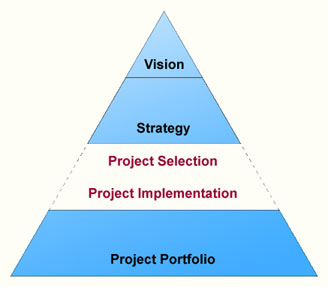
Each principle has a plethora of information about them. Any casual browse through the business section of a bookstore would see books specialising on one of the principles of managing by project. However, without the holistic method that binds it all together, the pieces of the puzzle don't match and the cohesiveness of the organisation fails. Each principle is dependent on the effectiveness of others. A weak vision results in an underachieving strategy, poor project selection and implemented projects that offer little value add. An inspiring vision not backed by a coherent, measurable strategy leaves too many projects being delivered in the rush to reach the end goal (with still no idea as to what to do when you get there). Projects are never implemented as resourcing is limited and multi-tasking rife. If both the vision is inspiring and the strategy right but the projects are selected based on political rather than objective means then value is destroyed and the strategy is never executed (only the PMs are). And finally, if the Vision is inspiring, the strategy right, the projects prioritised on objective lines but the implementation, the hardest element of all, is poor then again, the strategy cannot be executed and the vision remains a pipe dream.
One of the keys to implementation is for projects to be delivered by heterogenous teams that focus on the stated metrics or outcomes that drive value in the project, not just on the delivery of the project. The culture of these teams is one centred on value creation and hence it is the team that is likely to kill a project that no longer adds value (obviously this requires a non-blame culture and may even include rewards for teams that spot early when to cancel a project). This type of "fall on your sword" approach to projects relies on limited machiavellian activities and an environment where adapting to change is the norm.
The main method for implementing the filtering of projects is known as the funnels and filters or stage gate approach. This is best represented by the following diagram:
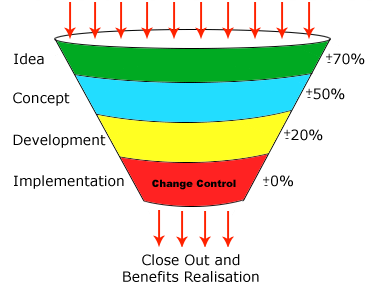
One can see from the diagram that there is a certain Darwinian evolution going on with the ideas that are thought of; only the fittest survive. The funnels and filters method is so commonly preached by our business and is often implemented by organisations, but without the cultural elements described above, the method again becomes a tick a box management method.
Sunday, September 03, 2006
current research
We're currently researching the following topics at mbh:
- Complexity theory and how it relates to management,
- Theory of constraints and its applications in project management,
- Option pricing on real assets,
- Why return on investment models are not applied in some organisations,
- Management structure models from matrix and cross-functional to functional,
- Methods for creating optimised portfolios of real investments and how these portfolios might be modelled.
We will be updating this blog with progress and findings in each of these areas of interest.
- Complexity theory and how it relates to management,
- Theory of constraints and its applications in project management,
- Option pricing on real assets,
- Why return on investment models are not applied in some organisations,
- Management structure models from matrix and cross-functional to functional,
- Methods for creating optimised portfolios of real investments and how these portfolios might be modelled.
We will be updating this blog with progress and findings in each of these areas of interest.
Friday, August 18, 2006
mbh consulting blog purpose
Welcome to the mbh consulting blog. This blog is where mbh consultants will compile anecdotes and experiences from our daily consulting lives. Hopefully, sharing this information will help others and prevent some of the pain and suffering that is project and change management in a commercial environment.
Subscribe to:
Posts (Atom)