Well, as can easily be seen, we've done a great job updating this blog. Truth is we've just had no time. mbh has grown by 100% this year as measured by full time equivalents and revenue (thankfully, profits have grown by a greater % than this). With all the work that's come in the door, sadly, the blog has been left by the wayside. Some of the things that have been keeping us busy include:
Deployment of UniPhi to 300 users in 11 offices around Australia for Davis Langdon
Establishment of an office in Adelaide to support several projects there including continued business case capability development across the SA Government, compiling business cases for the Health Department and Bio innovation SA and conducting a whole of government project management maturity survey. I will include more about this survey pending permission from the SA Government.
Further product development and research into consulting opportunities in Russia and South American Agricultural industries. We are in the final stages of a business plan for this work which has been fascinating to be involved with.
One of this things I will attempt to blog about over the next few days is work we have been doing in researching triple bottom line methodologies in use. Part of this has come out of work with SA Government on measurement criteria for their business cases. From this catalyst, further research and ideas have been developed. More on that soon....
Showing posts with label mbh. Show all posts
Showing posts with label mbh. Show all posts
Thursday, June 12, 2008


Sunday, January 14, 2007
Happy New Year
Hello all that read our blog. As can be seen below, it has been disgustingly dearth of content of late. There are plenty of excuses but none really suffice so I won't attempt to deceive you with them. We have however been very busy. December saw our first field trip to Russia. After researching and promoting the ILRIC turnkey product for the past 3 years, it was pleasant to finally get our hands dirty in the land of one of our target countries. The trip was a big success and we will be back in Russia again regularly this year. All of this is probably meaningless as most of our ILRIC research has been confidential. Sadly most of it continues to be so. There are some details I can share however, and will do so now.
ILRIC is a major national research facility set up in Armidale NSW. It was one of 15 such facilities but was the only one whose mandate was that of Agriculture. This mandate was relatively tight in terms of scope. The projects were approved when the facility was established and have all now been successfully implemented or cancelled. There was however, a small discretionary budget for the organisation to use to try and make itself sustainable post 30 June 2006 when the facility funds were closed. It was obvious to the CEO of ILRIC that the existing set of projects were never going to fund ILRIC post 2006 and hence he began a number of feasibility studies into ideas that his core partners had developed but not commercialised. One idea that he really liked was the idea of establishing infrastructure and genetics (specifically cattle) into developing countries. Many organisations including the WTO were already funding and running projects of this nature, but very few were from Australian consortiums. He believed that Australia has many unique advantages that sets itself up for this type of project.
mbh was procured to conduct the first market study into this concept. This was completed in 2004 and resulted in the ranking of 220 countries in terms of their priority and potential for importing cattle for the purpose of seedstock. From this priority list, ILRIC has made several successful visits resulting in leads and commissioned work that has established the company post 30 June last year. The biggest opportunities currently reside in Russia and a number of projects are awaiting approval. Once approved, ILRIC and mbh will partner with many other Australian organisations to deliver a total end to end market system for the production of beef.
It has already been a fascinating ride to date and I hope to regale you with stories from afar over the coming months.
I hope you have all had a wonderful New Year and wish you the best of luck in your respective businesses in 2007.
ILRIC is a major national research facility set up in Armidale NSW. It was one of 15 such facilities but was the only one whose mandate was that of Agriculture. This mandate was relatively tight in terms of scope. The projects were approved when the facility was established and have all now been successfully implemented or cancelled. There was however, a small discretionary budget for the organisation to use to try and make itself sustainable post 30 June 2006 when the facility funds were closed. It was obvious to the CEO of ILRIC that the existing set of projects were never going to fund ILRIC post 2006 and hence he began a number of feasibility studies into ideas that his core partners had developed but not commercialised. One idea that he really liked was the idea of establishing infrastructure and genetics (specifically cattle) into developing countries. Many organisations including the WTO were already funding and running projects of this nature, but very few were from Australian consortiums. He believed that Australia has many unique advantages that sets itself up for this type of project.
mbh was procured to conduct the first market study into this concept. This was completed in 2004 and resulted in the ranking of 220 countries in terms of their priority and potential for importing cattle for the purpose of seedstock. From this priority list, ILRIC has made several successful visits resulting in leads and commissioned work that has established the company post 30 June last year. The biggest opportunities currently reside in Russia and a number of projects are awaiting approval. Once approved, ILRIC and mbh will partner with many other Australian organisations to deliver a total end to end market system for the production of beef.
It has already been a fascinating ride to date and I hope to regale you with stories from afar over the coming months.
I hope you have all had a wonderful New Year and wish you the best of luck in your respective businesses in 2007.
Tuesday, September 26, 2006
the managing by project philosophy
Central to all that we do at mbh is the managing by project philosophy. Unfortunately, as people seem to have very short attention spans, a lot needs to be conveyed in a name. We tried to encapsulate what is an exhaustive philosophy and underpinning methodology into a name by using the term managing by project. Unfortunately, this has created two problems when first introducing the concept to a new audience. The first is that as there is such an array of definitions for what a project is, the term conjures up different images depending on the definition being used by the receiver of the term. The second issue is that many people assume managing by project means running lots of projects. Never has there been a more erroneous assumption. Business as usual, or the role of current operational functions are of immense importance to the managing by project philosophy as they reflect the current industry position of the organisation (in essence they are the outcomes of the series of projects that have been undertaken in the organisations history to get to this point in time).
I will attempt, over the next few blog entries, to articulate what the managing by project philosophy is and would welcome any comments you have as to how I have succeeded in this articulation.
Firstly, managing by project is a business management philosophy, therefore it applies to organisations only. However, it is a philosophy that we believe should be applied by all organisations. managing by project begins with two basic assumptions; 1) Any organisation's aim is to maximise the value they can create for their stakeholders and 2) Most value is created at the interstices of the array of functions that make up an organisation.
The reason managing by project works for all organisations is that all that changes from organisation to organisation is the value proposition. The philosophy and methodology used to deliver that value should not. For example, a for profit publicly listed company has a value proposition to maximise shareholder value. A non-profit charity organisation might have a value proposition to eliminate/alleviate poverty in a certain area. managing by project is in our opinion, the best philosophy and methodology available to both organisations to achieve their respective value propositions.
The first managing by project observation is that organisations are in a constant state of change. The drivers of this change are both external and internal. Management's job is to manage the change in a way that optimises the potential for the organisation to move towards a vision defined by the leaders of the organisation (the trick comes when the organisation attains its vision - more about that in a future blog).
The most effective method for managing the change is to create and amend an evolving portfolio of projects that are designed around delivering the vision for the company. This change management model involves principles represented in the managing by project triangle below:

Each principle has a plethora of information about them. Any casual browse through the business section of a bookstore would see books specialising on one of the principles of managing by project. However, without the holistic method that binds it all together, the pieces of the puzzle don't match and the cohesiveness of the organisation fails. Each principle is dependent on the effectiveness of others. A weak vision results in an underachieving strategy, poor project selection and implemented projects that offer little value add. An inspiring vision not backed by a coherent, measurable strategy leaves too many projects being delivered in the rush to reach the end goal (with still no idea as to what to do when you get there). Projects are never implemented as resourcing is limited and multi-tasking rife. If both the vision is inspiring and the strategy right but the projects are selected based on political rather than objective means then value is destroyed and the strategy is never executed (only the PMs are). And finally, if the Vision is inspiring, the strategy right, the projects prioritised on objective lines but the implementation, the hardest element of all, is poor then again, the strategy cannot be executed and the vision remains a pipe dream.
One of the keys to implementation is for projects to be delivered by heterogenous teams that focus on the stated metrics or outcomes that drive value in the project, not just on the delivery of the project. The culture of these teams is one centred on value creation and hence it is the team that is likely to kill a project that no longer adds value (obviously this requires a non-blame culture and may even include rewards for teams that spot early when to cancel a project). This type of "fall on your sword" approach to projects relies on limited machiavellian activities and an environment where adapting to change is the norm.
The main method for implementing the filtering of projects is known as the funnels and filters or stage gate approach. This is best represented by the following diagram:

One can see from the diagram that there is a certain Darwinian evolution going on with the ideas that are thought of; only the fittest survive. The funnels and filters method is so commonly preached by our business and is often implemented by organisations, but without the cultural elements described above, the method again becomes a tick a box management method.
I will attempt, over the next few blog entries, to articulate what the managing by project philosophy is and would welcome any comments you have as to how I have succeeded in this articulation.
Firstly, managing by project is a business management philosophy, therefore it applies to organisations only. However, it is a philosophy that we believe should be applied by all organisations. managing by project begins with two basic assumptions; 1) Any organisation's aim is to maximise the value they can create for their stakeholders and 2) Most value is created at the interstices of the array of functions that make up an organisation.
The reason managing by project works for all organisations is that all that changes from organisation to organisation is the value proposition. The philosophy and methodology used to deliver that value should not. For example, a for profit publicly listed company has a value proposition to maximise shareholder value. A non-profit charity organisation might have a value proposition to eliminate/alleviate poverty in a certain area. managing by project is in our opinion, the best philosophy and methodology available to both organisations to achieve their respective value propositions.
The first managing by project observation is that organisations are in a constant state of change. The drivers of this change are both external and internal. Management's job is to manage the change in a way that optimises the potential for the organisation to move towards a vision defined by the leaders of the organisation (the trick comes when the organisation attains its vision - more about that in a future blog).
The most effective method for managing the change is to create and amend an evolving portfolio of projects that are designed around delivering the vision for the company. This change management model involves principles represented in the managing by project triangle below:
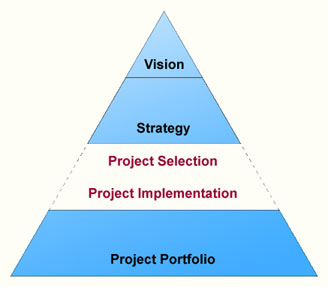
Each principle has a plethora of information about them. Any casual browse through the business section of a bookstore would see books specialising on one of the principles of managing by project. However, without the holistic method that binds it all together, the pieces of the puzzle don't match and the cohesiveness of the organisation fails. Each principle is dependent on the effectiveness of others. A weak vision results in an underachieving strategy, poor project selection and implemented projects that offer little value add. An inspiring vision not backed by a coherent, measurable strategy leaves too many projects being delivered in the rush to reach the end goal (with still no idea as to what to do when you get there). Projects are never implemented as resourcing is limited and multi-tasking rife. If both the vision is inspiring and the strategy right but the projects are selected based on political rather than objective means then value is destroyed and the strategy is never executed (only the PMs are). And finally, if the Vision is inspiring, the strategy right, the projects prioritised on objective lines but the implementation, the hardest element of all, is poor then again, the strategy cannot be executed and the vision remains a pipe dream.
One of the keys to implementation is for projects to be delivered by heterogenous teams that focus on the stated metrics or outcomes that drive value in the project, not just on the delivery of the project. The culture of these teams is one centred on value creation and hence it is the team that is likely to kill a project that no longer adds value (obviously this requires a non-blame culture and may even include rewards for teams that spot early when to cancel a project). This type of "fall on your sword" approach to projects relies on limited machiavellian activities and an environment where adapting to change is the norm.
The main method for implementing the filtering of projects is known as the funnels and filters or stage gate approach. This is best represented by the following diagram:
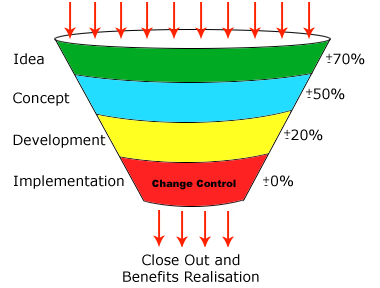
One can see from the diagram that there is a certain Darwinian evolution going on with the ideas that are thought of; only the fittest survive. The funnels and filters method is so commonly preached by our business and is often implemented by organisations, but without the cultural elements described above, the method again becomes a tick a box management method.
Sunday, September 03, 2006
current research
We're currently researching the following topics at mbh:
- Complexity theory and how it relates to management,
- Theory of constraints and its applications in project management,
- Option pricing on real assets,
- Why return on investment models are not applied in some organisations,
- Management structure models from matrix and cross-functional to functional,
- Methods for creating optimised portfolios of real investments and how these portfolios might be modelled.
We will be updating this blog with progress and findings in each of these areas of interest.
- Complexity theory and how it relates to management,
- Theory of constraints and its applications in project management,
- Option pricing on real assets,
- Why return on investment models are not applied in some organisations,
- Management structure models from matrix and cross-functional to functional,
- Methods for creating optimised portfolios of real investments and how these portfolios might be modelled.
We will be updating this blog with progress and findings in each of these areas of interest.
Friday, August 18, 2006
mbh consulting blog purpose
Welcome to the mbh consulting blog. This blog is where mbh consultants will compile anecdotes and experiences from our daily consulting lives. Hopefully, sharing this information will help others and prevent some of the pain and suffering that is project and change management in a commercial environment.
Subscribe to:
Posts (Atom)